Matías Golman

I am a labour economist. I work on how to create jobs that allow people to have a decent and fulfilling life.

Matías Golman

I teach applied economics at Utrecht University and I consult for the International Labour Organization. Before that I worked at the OECD and the World Bank. Most of what I have done is about informal employment, skills, and what firms ask of workers, mainly in Latin America and in Europe.

What I enjoy most is the question itself, and I pick the method to fit it rather than the other way round. Applied econometrics when the point is to identify an effect, text as data and machine learning when the evidence sits in millions of observations, and sometimes no quantitative method at all. What does not change is the care about choosing the right tool, and about the details that decide whether an answer holds. One problem usually has several solutions and there is almost always a perspective nobody has tried yet, so I am as glad to work on poverty, inequality, migration, minimum wages or education as on what I have already published.

I am open to consultancy, research collaborations and policy projects. Write to me if something here is useful to you.

What I am curious about

Informal employment

Who works informally, why, and which policies actually move people out of it. Diagnostics for Costa Rica and Argentina, and a meta-analysis of 79 evaluations across Latin America.

Skills and what firms ask for

What millions of job vacancies reveal about the skills and personal qualities employers want, how that changes when firms adopt AI, and what it costs workers.

Transitions and social protection

How people move between jobs, unemployment and inactivity, and how well income protection holds up at the points where they are most exposed.

Making data usable

Survey microdata, text as data, and the slower work of turning a result into something a ministry or an agency can act on.

Current work

  • 2026

    Artificial intelligence and personality traits

    Abstract

    Using text analysis of 11.7 million UK online job postings from 2017 to 2022, drawn from a near-universe dataset of online vacancies, we construct measures of Big Five personality traits and AI-related skill requirements from job descriptions. At the vacancy level, positions requiring AI-related skills are significantly more likely to demand openness to experience and less likely to demand the remaining four traits, after controlling for firm, occupation, location and time fixed effects. This pattern is distinct from the profile of postings requiring general computer skills, which suggests the association with openness is specific to AI knowledge rather than to broader digital requirements. At the firm level, staggered difference-in-differences estimates show that when firms expand AI-related hiring, their demand for openness rises across all postings, including non-AI vacancies within occupation groups. The results are consistent with firms that seek to integrate AI knowledge valuing creative workers who can adapt to new tools and approaches, and extending this preference beyond the roles that directly involve AI.

  • 2026

    The value of personality

    Abstract

    Jobs that mention personality traits offer 4.6% lower wages on average, which raises a paradox. Why advertise for traits that are penalised? Using 11.7 million UK job postings (2017 to 2022), I test four explanations, namely correlation with low-pay job characteristics, compensating differentials, linguistic intensity, and demographic targeting. Occupation fixed effects absorb the most, but significant penalties remain. Penalties are larger in high-skill occupations, smaller in female-dominated roles, and rise sharply with the intensity of the language used. Employers appear to use trait language for several purposes at once rather than one.

  • 2026

    The effectiveness of formalisation policies in Latin America

    Abstract

    The first comprehensive meta-analysis of formalisation policies in Latin America, covering 79 impact evaluations, 527 estimates and interventions from 1990 to 2020, including Spanish-language studies and unpublished government reports that earlier reviews missed. Formalisation policies mostly work, and adverse effects are rare (5.1% of estimates), although publication bias substantially reduces effect sizes once corrected. Active labour market policies, information campaigns and labour inspections raise formality. Social protection programmes with activation components produce the largest earnings effects but barely move formality at all. Benefits strengthen over time, and multi-component interventions outperform single-component ones.

All research and policy work

Things I have built

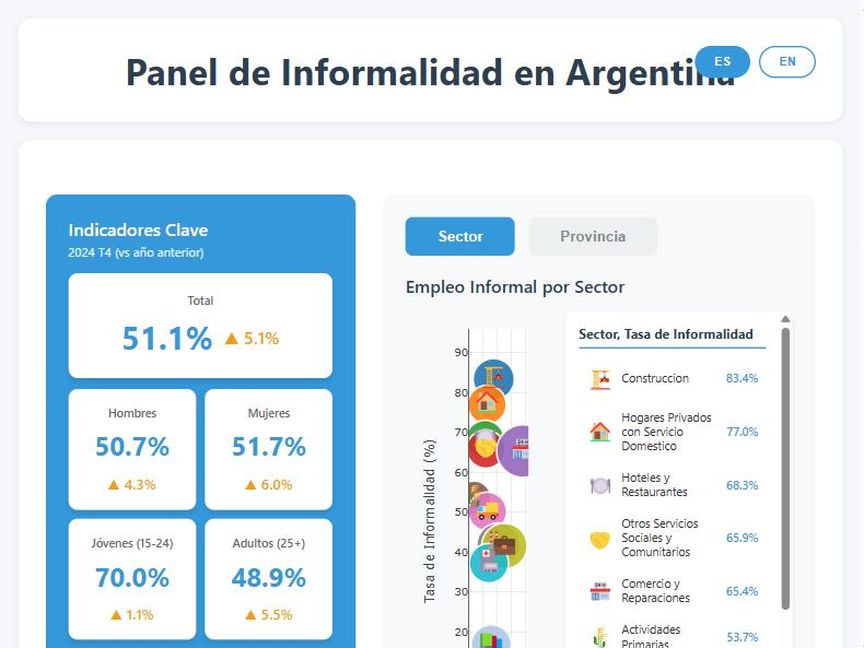
Screenshot of the Argentina informality dashboard showing charts and a provincial map

Argentina Informality Dashboard

An interactive tool, built for the ILO and Argentina's labour ministry, that turns two decades of household survey microdata into something a policy officer can actually use. It covers informal employment from 2003 onwards, broken down by sector, province, sex and age, and the time series are coded so they can be reproduced each quarter rather than rebuilt by hand.

Built for the ILO. Data from INDEC's Permanent Household Survey (EPH), 2003 onwards.

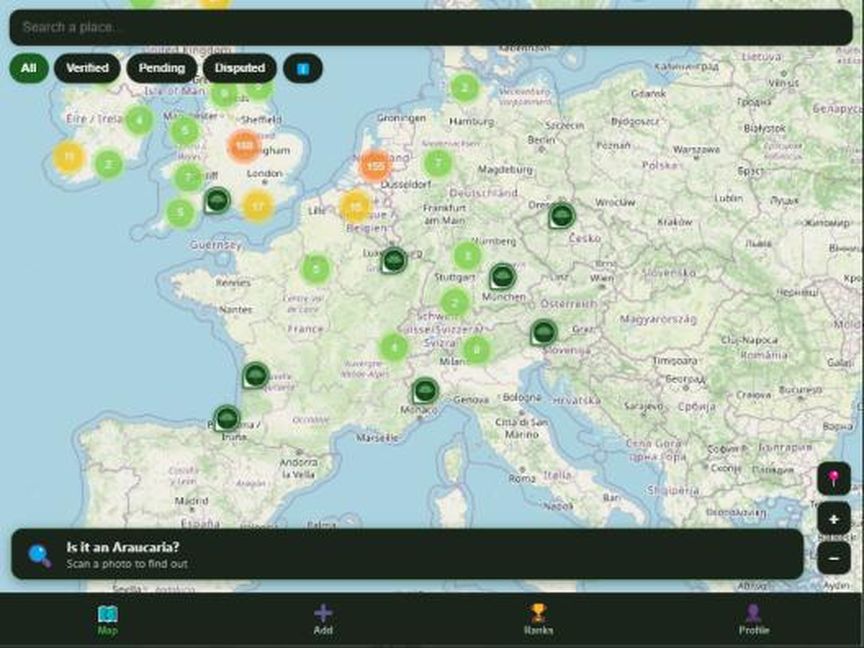
Screenshot of the Araucaria Spotter app showing a map with recorded trees

Araucaria Spotter

A community map of the Araucaria araucana, the monkey puzzle tree, growing outside its native range in the Andes. It started as a game of spotting them on the street, and turned into an app so that other people could add the ones they find. The map shows how far the species has travelled.

More than 500 trees recorded around the world so far, and more coming in every day. Web app now, on Google Play soon.